


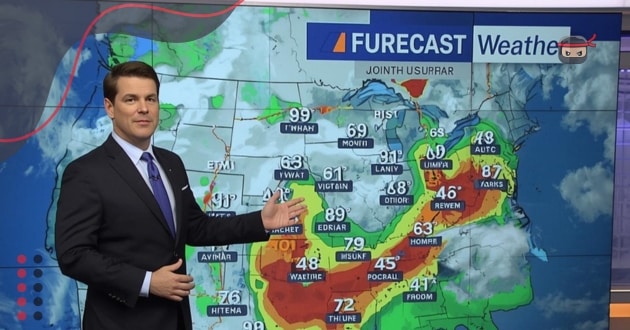
Weather forecast news today reveals a scenario of alarming changes that have altered Canada.
Following the Weather forecast news today is essential, as the country simultaneously faces an explosive cyclogenesis in the Atlantic and a sudden freeze in the Prairies, demanding immediate attention from all citizens.
Today you will see all the information from Weather forecast news today, allowing you to learn everything about climate change in a short time.
07 Main weather forecast news today

1. Atlantic Weather Bomb
The most critical updates focus on the province of Newfoundland and Labrador, where a high-energy low-pressure system is in full development.
This phenomenon, technically classified as “bombogenesis,” occurs when the central pressure drops more than 24 millibars in 24 hours.
Weather forecast news today highlights that St. John’s could register a new low-pressure record for November, approaching the all-time historic low of 945 mb in 2003, suggesting a long-duration event with intense kinetic energy.
The interaction between this massive system and the local topography generates a scenario of extreme danger. In St. John’s and the Avalon Peninsula, sustained southerly winds at 80 km/h will intensify, reaching gusts between 110 and 120 km/h overnight.
Exposed areas like Trepassey and Bonavista face even more severe prognostics, with gusts that could reach 130 km/h.
2. Hydrological and Maritime Impacts
In addition to wind force, Weather forecast news today emphasizes the tropical moisture load transported by the system.
Parts of Newfoundland and Cape Breton are expected to receive rainfall accumulations between 30 to 75 mm in a short interval.
The intensity of this precipitation, combined with possibly saturated or partially frozen ground, drastically increases the risk of rapid surface runoff.
This indicates localized flooding in urban areas and smaller watersheds as a direct consequence of this volume of water.
The Sable Island region and the southeast coast of Newfoundland will face waves of 7 to 8 meters.
The dangerous combination of high tide, extremely low atmospheric pressure, and stormy winds creates a scenario conducive to severe coastal erosion and flooding in coastal zones.
3. The “Alberta Clipper” (Weather forecast news today)
While the east struggles against oceanic winds, for the Prairie provinces, the effects of an “Alberta Clipper” are described.
This low-pressure system, although fast, is depositing massive amounts of snow and generating zero visibility conditions in Alberta and Saskatchewan.
The reported snow accumulations are critical.
The Cypress Hills region and communities like Coronach, Climax, Eastend, and Maple Creek expect to receive up to 20 cm of snow.
Regina, the capital of Saskatchewan, has already registered about 17 cm. Regional variability is a key point in the Weather forecast news today, with Holbein registering 11.4 cm and Prince Albert 7 cm, demonstrating how local geography influences snow deposition.
The dry, light snow, resulting from low temperatures, is easily transported by the wind, creating “whiteout” conditions. This warns that visibility has been reduced to less than 500 meters in vast areas, setting up blizzard scenarios even where precipitation has already ceased.
4. Logistical Collapse in Alberta
A freezing rain phenomenon has paralyzed vital infrastructure in northern and central Alberta.
The rain, falling onto surfaces with negative temperatures, created instantaneous black ice layers, leading to Highway 63, an essential route for transporting equipment to the Fort McMurray oil sands, being declared “nearly impassable” by the RCMP.
The geographical extent of the warnings covers agricultural and residential communities in the center of the province.
Wetaskiwin County, Leduc, and Camrose County are under severe alerts.
Explicit recommendations from Alberta 511. And the RCMP instruct drivers to avoid all travel on these routes to preserve lives in the face. Of the extreme risk of accidents and blockages on highways like Highway 43 near Whitecourt.
5. Baroclinic Transition in Ontario and Quebec
Central Canada is experiencing a thermal “roller coaster,” as explained by. Toronto and southern Ontario start the week with mild temperatures of 9°C, but the approach of a cold front will bring a drastic change.
The news predicts an abrupt drop to reach -1°C on Wednesday and -5°C on Friday.
This transition will result in the “flash freeze” phenomenon, turning residual water on the roads into dangerous ice.
In northeastern Ontario, indicates that the “lake effect snow machine” will be activated by strong northerly winds.
Communities around Lake Superior must prepare to face accumulations of up to 30 cm of snow.
6. Parade of Storms in British Columbia (Weather forecast news today)
The Pacific coast faces an Atmospheric River pattern. Squamish and Zeballos have already registered over 60 mm of rain, and the forecast points to an additional 50 to 100 mm for the North Shore and the west of Vancouver Island.
Also warns about destructive southeast winds in Metro Vancouver and Greater Victoria. With gusts of 90 km/h capable of causing power outages.
The coincidence of astronomically high tides, or “King Tides,” with the storm a critical point in Weather forecast news today.
Environment Canada has issued coastal flood warnings to alert about water piling up due to the wind.
7. Thermal Anomalies in the North

The Canadian Arctic presents disturbing contrasts.
Nunavut is experiencing anomalous warming, driven by an atmospheric block that channels mild air from the Pacific.
Cambridge Bay registers temperatures 5°C above normal, while Baker Lake is 8°C above average.
In contrast, Yellowknife faces deep cold. News reports wind chill temperatures of up to -53°C.
Public health warnings recommend covering all exposed skin to prevent frostbite in minutes.
Furthermore, communities like Paulatuk face blizzards with zero visibility, isolating entire populations. As detailed in the latest Weather forecast news today updates.
Conclusion (Weather forecast news today)
The Weather forecast news today makes it clear that Canada is facing one of the most complex and dangerous meteorological episodes in recent years.
Torrential rains in the Atlantic, gusts above 120 km/h, black ice paralyzing Alberta, historic snowfalls in the Prairies, atmospheric rivers in British Columbia,. Besides extreme thermal contrasts in the Arctic, compose a climate mosaic that demands continuous vigilance.
The country is under multiple simultaneous atmospheric dynamics: bombogenesis, Alberta Clipper, atmospheric rivers, and flash freeze. Each has severe impacts on transportation, energy, infrastructure, and public safety.
In such a volatile scenario, following the Weather forecast news today is a practical necessity to protect lives, plan movements, and understand the rapid evolution of climatic conditions.
This week’s outlook shows that extreme events are becoming more frequent and intense, reinforcing the importance of constant preparation and access to reliable real-time information.
Science plays a great role in society. Therefore, it is important to pay attention to all technology news and trends. Thus, you will know how science has advanced, helping to improve the climate situation.