



Leaving money idle in the bank is expensive. With inflation at 3.1% and Bank of Canada interest rates at 2.50%, your savings lose real value daily without personal investing Canada.
Many residents lose money because they are unaware of the tax exemptions available. Learn how to allocate every cent to profit more and pay less tax with personal investing Canada.
What would you like to explore?
Choose a category to review available credit card options and information.
Follow the guidelines below to protect your income against inflation and master personal investing Canada.
Why has leaving money idle become a loss in Canada? (Personal investing Canada)
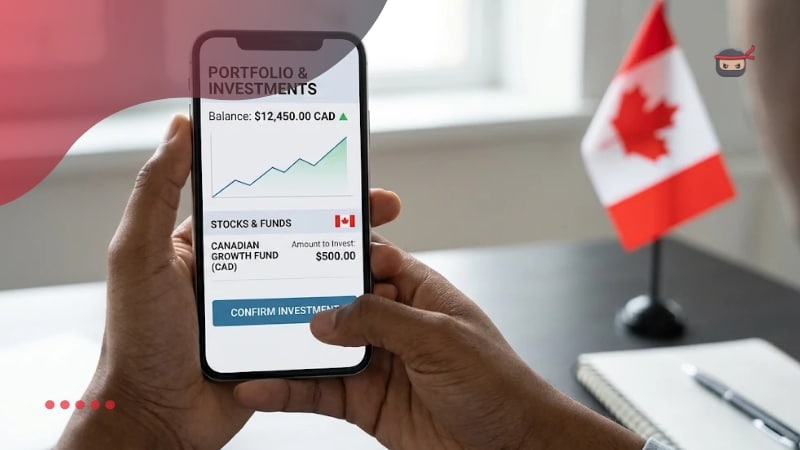
The Canadian financial market changed at the end of 2026. In October, the Bank of Canada raised the benchmark interest rate to 2.50%, the first increase in three years.
With annual inflation at 3.1%, any investment that yields less than that loses purchasing power to the cost of living.
Therefore, investing in the country requires more than traditional savings: it is necessary to combine tax efficiency and assets that outperform inflation in the long term.
How to pay less tax using government registered accounts?
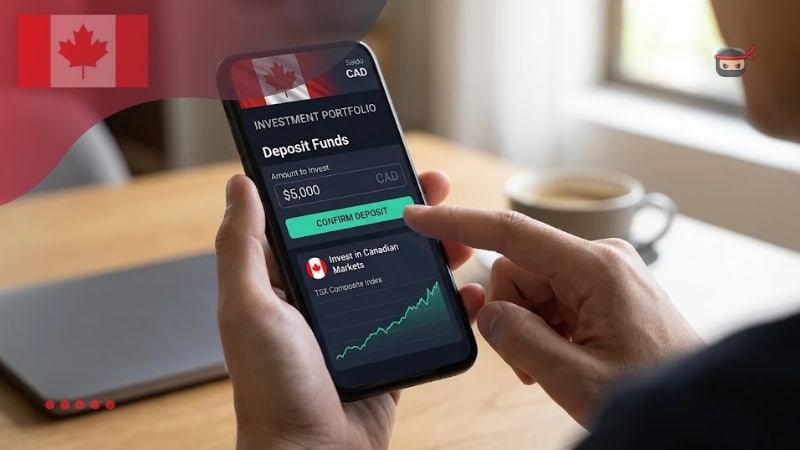
The Canadian government offers registered accounts that shield your earnings from taxes. The Canada Revenue Agency (CRA) regulates these plans, and knowing the 2026 limits is essential.
1. TFSA is the secret to profiting tax-free
The Tax-Free Savings Account (TFSA) is the most flexible account for investors in the country.
All income generated within it, such as dividends or capital gains, is exempt from taxes upon withdrawal.
In 2026, the annual TFSA contribution limit is CA$ 7,000.00. Residents since 2009 who have never contributed accumulate up to CA$ 109,000.00 in contribution room.
Pay attention to transaction rules: withdrawn amounts only return to your contribution room on January 1st of the following year.
Avoid exceeding the allowed ceiling. Excess deposits incur a penalty of 1% per month on the over-contributed amount.
2. Use the RRSP to reduce your income tax today
The Registered Retirement Savings Plan (RRSP) works as a tax deduction for higher income brackets.
Each deposit directly reduces the calculation base for your Income Tax in the current tax year.
In 2026, the contribution limit is 18% of the previous year’s income, up to a cap of CA$ 33,810.00.
Thus, the money grows tax-free inside the plan for decades.
Tax is due only upon withdrawal during retirement, when income tax rates are usually lower.
3. FHSA to achieve homeownership faster (Personal investing Canada)
The First Home Savings Account (FHSA) combines tax deductions on contributions (like the RRSP) with tax-free withdrawals for purchasing a first home (like the TFSA).
The annual limit is CA$ 8,000.00, with a lifetime cap of CA$ 40,000.00. Unused annual limits can be carried forward to the following year (up to an additional CA$ 8,000.00).
This allows contributions of up to CA$ 16,000.00 in a single year to accelerate the purchase of a property.
Where to keep your emergency fund without losing to inflation?
Before investing in equities, protect your short-term capital with conservative, highly liquid options in the Canadian market.
1. Cash ETFs and government bonds
High-interest savings exchange-traded funds (ETFs) adjusted returns under OSFI rules in 2026, but they continue to yield more than chequing accounts.
Even so, they remain far superior to standard chequing accounts.
The Global X High Interest Savings ETF (CASH.TO) offers around 2.01% annually (MER of 0.11%). The Global X 0-3 Month T-Bill ETF (CBIL), focused on short-term government treasury bills, yields around 2.42% annually.
Meanwhile, the BMO Money Market Fund ETF (ZMMK) invests in short-term corporate and government securities, yielding around 2.28% annually.
2. Guaranteed Investment Certificates (Personal investing Canada)
For fixed terms, Guaranteed Investment Certificates (GICs) function similarly to fixed-rate bonds and are good options for 2026.
Institutions such as Haventree and EQ Bank offer non-redeemable GICs with rates between 4.15% (2 years) and 4.25% annually (5 years), beating the 3.1% inflation rate with low risk.
However, these investments require keeping the invested capital locked until maturity.
What is the best all-in-one ETF to grow your wealth?
To build long-term wealth, 100% equity global ETFs are widely used. Reductions in management fee ratios have made these products even more accessible.
1. iShares XEQT
Managed by BlackRock, XEQT has over CA$ 18 billion in assets under management, standing out for its high liquidity and broad diversification across global equities.
The fund maintains around a 25% allocation to the Canadian market and a management fee of 0.17% (estimated MER between 0.19% and 0.20%). Dividend distributions are quarterly.
It is suitable for investors seeking global diversification in a single, highly liquid asset.
2. Vanguard VEQT
Vanguard‘s VEQT has a management fee of 0.17% (total MER of 0.20% per year). Its main distinction is annual dividend distributions.
Annual payouts simplify tax tracking in non-registered accounts. The fund allocates about 30% of its portfolio to the Canadian market.
It is ideal for those who prefer greater exposure to Canadian companies and lower payout frequency.
3. BMO ZEQT (Personal investing Canada)
ZEQT, from Bank of Montreal, features the lowest management fee in its category: 0.15% annually (projected MER of 0.18%).
The fund allocates 25% to Canadian stocks, pays quarterly dividends, and holds approximately CA$ 1.16 billion in assets.
It is recommended for investors focused on minimizing management costs.
Which brokerages and robo-advisors charge the lowest fees today?
You don’t need to pay high commission fees to invest. Brokerages like Questrade and Wealthsimple offer zero-commission trading for stocks and ETFs in Canada and the US.
Pay attention to currency conversion fees: platforms charge around 1.5% to convert Canadian dollars (CAD) into US dollars (USD).
Buying ETFs traded on the Toronto Stock Exchange (TSX) in CAD avoids this cost. For automated management, robo-advisors are practical alternatives:
- Questwealth Portfolios: Management fee of 0.25% per year (0.20% for balances over CA$ 100,000.00), average MER of 0.19%, and minimum initial investment of CA$ 1,000.00.
- Wealthsimple Invest: No initial minimum, with sustainable portfolios and a fee of 0.50% per year (0.40% for balances over CA$ 100,000.00).
- RBC InvestEase: Integrated with Royal Bank, charges 0.50% per year + taxes, with a CA$ 1,000.00 minimum and transfer fee rebates for contributions above CA$ 15,000.00.
How to start investing in Canada without making costly mistakes?
Organizing your finances before investing prevents common mistakes and ensures more efficient planning.
To structure your budget, check out our guide on financial planning in Canada.
After structuring your finances, follow this step-by-step guide:
- Build an emergency fund: Keep 3 to 6 months of expenses in safe, highly liquid assets (such as cash ETFs or treasury bills).
- Choose the right accounts: Use the FHSA for buying a home, the TFSA for tax-free flexibility, or the RRSP for Income Tax deductions.
- Track your contribution limits: Monitor your contributions manually, as the CRA My Account portal may take several months to update previous year balances.
- Automate your contributions: Set up recurring transfers to maintain investment consistency without relying on market timing.
Is it worth starting to invest in Canada this month?
Personal investing in Canada in 2026 protects your money against inflation and helps build wealth. Combining registered accounts (TFSA, RRSP, and FHSA) with ETFs or GICs maximizes your returns.
Choose a regulated brokerage, open your registered account, and start making consistent contributions.
Which account or investment do you plan to prioritize first? Leave your comment below!